
A Christian with Asterisks
An attempt at an Open & Relational Confession of Faith, and why I needed to try to write one.

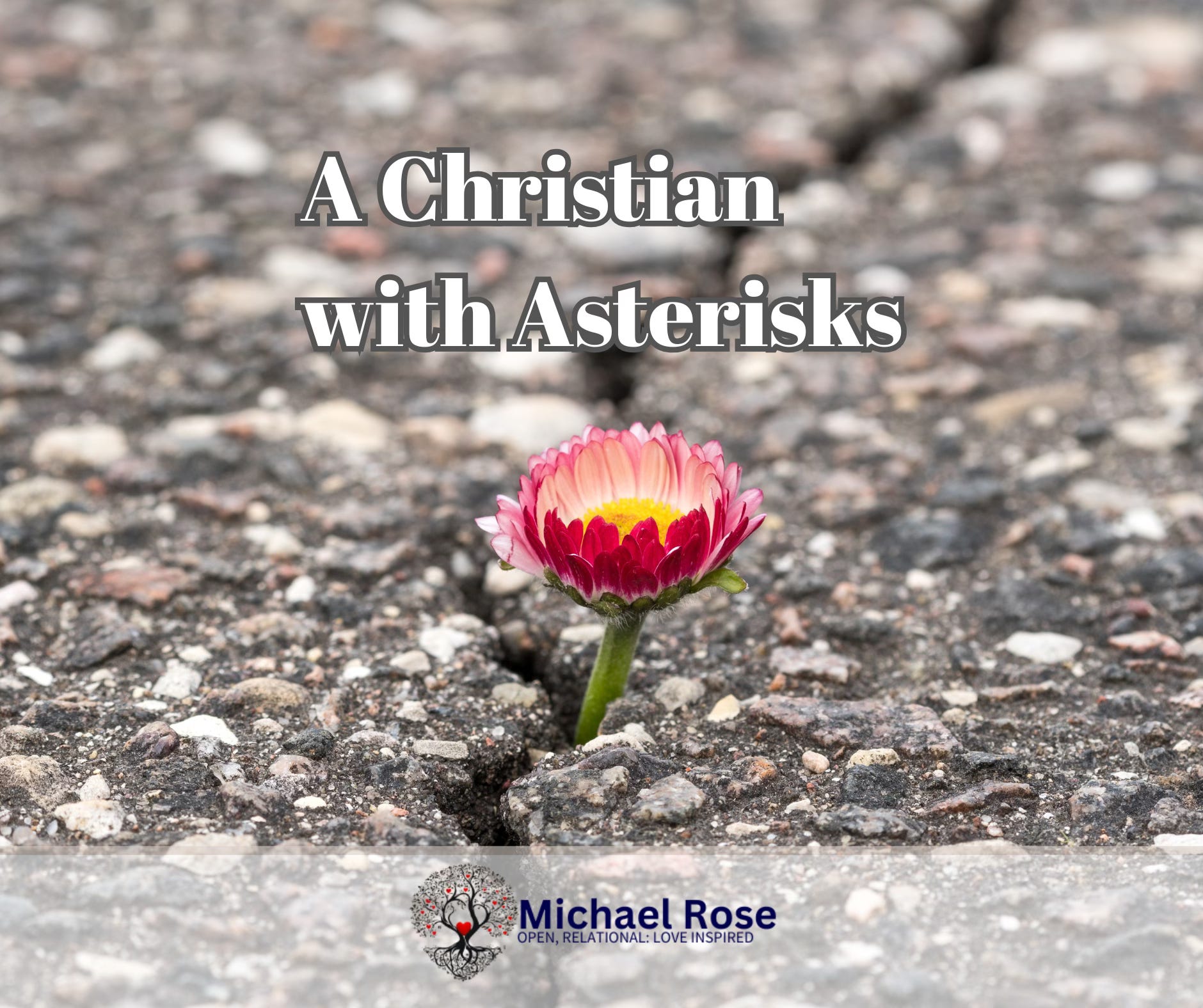
Ecotones are those in-between places where ecosystems meet—the edges where forest gives way to field, where river becomes prairie. They can be places of tension and overlap, conflict and harmony, but also synthesis and surprise—where new life shows up that doesn’t quite belong to either side.
For better or worse, that edge is familiar territory for me. It’s where I tend to stand—close enough to understand multiple worlds, distant enough to notice when the same words are doing very different work.
And sooner or later, someone asks the inevitable question: “Are you (even) a Christian?”
I usually take a breath, because I know it’s a loaded question. Most folks already have a definition of “Christian,” for good or for ill, so it’s often a kind of litmus test.
My usual answer: “Yes. I’m a Christian with asterisks.”
That’s shorthand for: I follow Jesus, sincerely, but I understand the faith a little differently than some assume. The asterisk often opens a conversation—not so I can win anyone over (I’ve mostly retired from that), but so we can be a little more honest about what we actually believe.
As for the ancient creeds, I respect them. I can honour them as the best wrestling of their time without treating them as final forms. For me, they’re more trajectory than granite—signposts in a living tradition that keeps learning, growing, and becoming.
So no, I’m not especially interested in creeds as absolutes or measuring sticks. But I am interested in faith-shaped stories and expression. Which made me wonder: what might a Christian creed sound like in an Open and Relational key?
If you must, gather your pitchforks and light your torches…
or just scroll on by. Either way, what follows is a work in progress—still becoming.
An Open and Relational Creed (a work in process)
We1 believe in God,
the living Source of all that is,
whose very nature is love—
not indifferent, not self-limiting, not all-controlling,
but present, purposeful, and responsive,
always seeking the flourishing of life.
We believe God’s power is not control,
but faithful self-giving—amipotence—
working within the law-like regularities
and genuine freedom of creation,
never abandoning the world God loves.
We believe God creates by invitation,
calling a universe into being
unfinished, evolving, and alive—
a world where creative possibility is real,
and where the future is still being formed.
We believe in Jesus, the Christ,
born of God’s love and fully human among us,
the clearest human expression of who God is,
and the embodied example of our becoming.
In his life, we see love in the flesh—
healing without force,
truth spoken with compassion,
mercy widening the circle of belonging.
In his suffering, we see God suffering with us, taking our pain into God’s own life.
In his death, we see love refusing the way of violence.
In his resurrection, we see God’s enduring commitment to life—
a promise that love continues,
that meaning is not extinguished,
that the story is not over.
We believe the Spirit is God’s living presence,
moving in and through all things,
awakening conscience, stirring courage,
inspiring novelty and beauty,
greater justice, and more abundant life,
drawing creation toward deeper unity—
where difference is held, not erased.
The Spirit does not compel,
but calls, lures, and empowers,
working patiently within each moment
to bring forth what can be made whole,
what can be reconciled,
what can yet become.
We believe the church is a community of practice,
formed not by certainty,
but by love—
called to listen deeply,
to tell the truth,
to tend wounds,
to celebrate life,
and to join God’s healing work in the world—
as companions and co-creators of the overall good.
We believe salvation is not escape from the world,
but the deepening and healing of relationship—
with God, with one another, with ourselves, and with the earth—
as love restores what has been broken,
renews what has grown weary,
and nurtures the becoming of the beautiful.
We believe we are drawn into this life of love—
to share in God’s own nature,
and to learn, over a lifetime,
the holy practice of loving well.
We believe the future is open,
held within God’s unwavering faithfulness
and shaped by the real choices of creatures.
What we do matters.
How we love matters.
The good we choose matters.
We trust that God is always at work,
not above the world, but within it,
bearing patiently the risk of sorrow and joy,
gathering what is scattered,
carrying all things forward
toward deeper communion and fuller life.
And so we live not in fear,
but in hope—
participating in love’s unfolding work,
joining the long labour of becoming,
until all things are made whole in Christ,
and creation awakens to its deepest unity in God.
As it was in the beginning,
is now,
and ever shall be:
Love without end.
Sola Caritas,
𝞃Michael
“We”: consider it a kind of royal we—a personal confession voiced in the plural, not a claim to speak for all (or any) Open and Relational thinkers.
Note:it’s worth saying this plainly: when I speak of Father, Son, and Spirit, I’m using trinitarian language as a set of relational images—windows for naming the depth and diversity of the One God’s life.
The fact that there’s no real community of “we” here is why this kind of thing just perpetuates the problem while claiming to resolve it. We don’t need one white man’s creed. We need communion. I sure wish all these exvangelical theobros would learn the difference.
Parts of this made my soul dance with yours. Keep dancing my friend.