
You Can’t Get There From Here
On stepping beyond the edge of the map. A story.

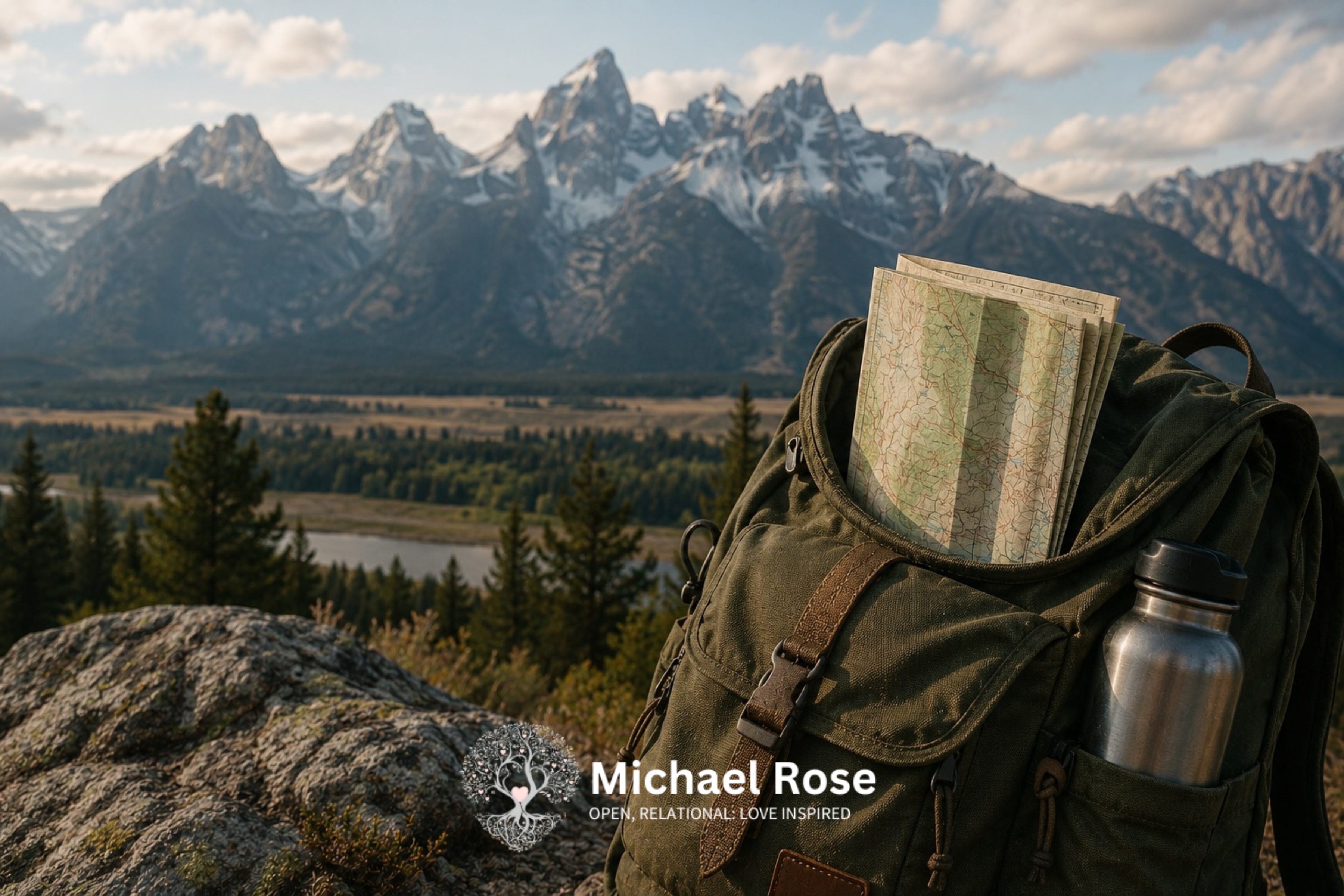
There was once a cartographer, a mapmaker for the rest of us, who devoted his life to making maps.
His maps were legendary. Every mountain was measured. Every river was carefully traced. Every village, every crossroads, and every hidden valley was recorded with astonishing precision. People travelled great distances to study his work, and he took quiet satisfaction in knowing that his maps had helped countless others find their way.
One autumn afternoon, an old woman arrived with a weathered walking stick and a wry smile that hinted she knew something the maps did not.
“I hear you’re searching for the Holy Mountain.”
“I am,” the mapmaker replied. “I’ve spent thirty years studying every account ever written. I’ve compared traditions, examined the landscape, interviewed pilgrims, and catalogued every known route.”
“And have you found it?”
“Not yet.”
“May I see your map?”
With care, he unrolled it across the table.
She studied it for a long time before looking up.
“This is a very good map.”
The cartographer smiled.
“Then why haven’t I found the mountain?”
She rested a finger near the edge of the parchment.
“Because you can’t get there from here.”
He frowned.
“What do you mean? Everything I know is on that map.”
She nodded.
“It is.”
He waited.
“Everything you know.”
He smiled politely, unsure whether she was complimenting him or teasing him.
She continued.
“Everything... except the first step.”
He laughed.
“Surely the first step comes after I’ve determined the correct route.”
“Sometimes.”
“And the rest?”
“Sometimes the road only appears after you begin walking.”
The answer stirred him.
Over the following months, he searched for better maps. He read philosophers who debated whether the mountain could even be known. Some argued that every path was an illusion. Others insisted there was only one true route. Still others devoted entire careers to explaining why no one could ever reach the summit.
His library grew, and so did his comprehension.
His boots, almost new, remained tucked away in the closet.
Years passed.
Then one spring morning, he found himself remembering the old woman’s words.
Everything... except the first step.
Without quite knowing why, he rolled up his finest map, placed it carefully in his pack, and began to walk.
The first days were filled with uncertainty. The trail often disappeared, and more than once he found himself relying on shepherds, children, and fellow travellers who could not explain exactly how they knew which way to go.
“I can’t prove it,” one young woman told him with a shrug, “but I think the path bends toward the light.”
Exasperated by the reply and biting his tongue, he chose instead to follow the path as it bends towards the light. Whatever that meant.
As the weeks became months, something unexpected happened.
The mountain did not become easier to understand. It became more mysterious. The closer he came, the larger it seemed. Valleys gave way to deeper valleys, and peaks disappeared into cloud. His questions compounded even as a quiet peace began to settle within him.
One evening another traveller asked, “Do you understand the mountain now?”
The mapmaker smiled.
“Less than ever.”
“Then why do you keep walking?”
He stared into the fire before answering.
“Because somewhere along the way I realized understanding was never the destination.”
“What is?”
He looked into the flames for a long while.
“Learning to step into what even my best maps can only point toward.”
Years later, standing high above the valleys he had crossed, he looked back over the long road behind him. The view was breathtaking, but it was not the landscape that stirred him most.
It was the journey.
For the first time, he saw that the holy mystery had not been waiting at the summit. It had been present when curiosity first stirred within him. It had been present when he first learned to ask good questions and when he carefully drew his earliest maps. It had accompanied every conversation, every disappointment, every wrong turn, every act of kindness, every glimpse of beauty, and every hope that refused to let him abandon the search.
Even the map had been an expression of love.
It had never been the whole story, but neither had it been a mistake. It had faithfully brought him to the edge of everything it could describe.
Then it had quietly invited him to continue beyond it.
Only then did he understand what the old woman had meant.
The map ends here.
The world does not.
A moment …
Perhaps faith is something like this.
We honour the mind because it teaches us to think carefully. It exposes false certainty, asks better and more honest questions, and cultivates humility. Reason is a gift. Science is a gift. Theology is a gift. Every good map deserves our gratitude.
But eventually every map asks something more of us. It quietly invites us to fold it up, shoulder our pack, and take the first step. Not because the map has failed, but because it has fulfilled its purpose.
Some realities cannot be known from a distance. Love cannot be mastered by reading (or even writing) about it. Friendship cannot be experienced by analysis and spreadsheets alone. Beauty cannot be reduced to scales of measurement. Even our finest theology cannot contain God.
At some point, what we long for requires us to step beyond the edge of the map. Not blindly. Not by abandoning reason. But by allowing reason to carry us as far as it can, until hope, trust, and love invite us to take one more step in faith.
Perhaps the deepest truths are participatory rather than merely observational.
Sola Caritas,
𝞃Michael

That's beautiful, Michael. Breathtaking and wise. And exquisitely written. Is it from your book, or something new you have just written?