
What If Love Is Deeper Than Despair?
In a world shaped by outrage, anxiety, and algorithms designed to keep us afraid, I went looking for goodness along the Milk River and found myself wrestling with a strange question: Why is there Good

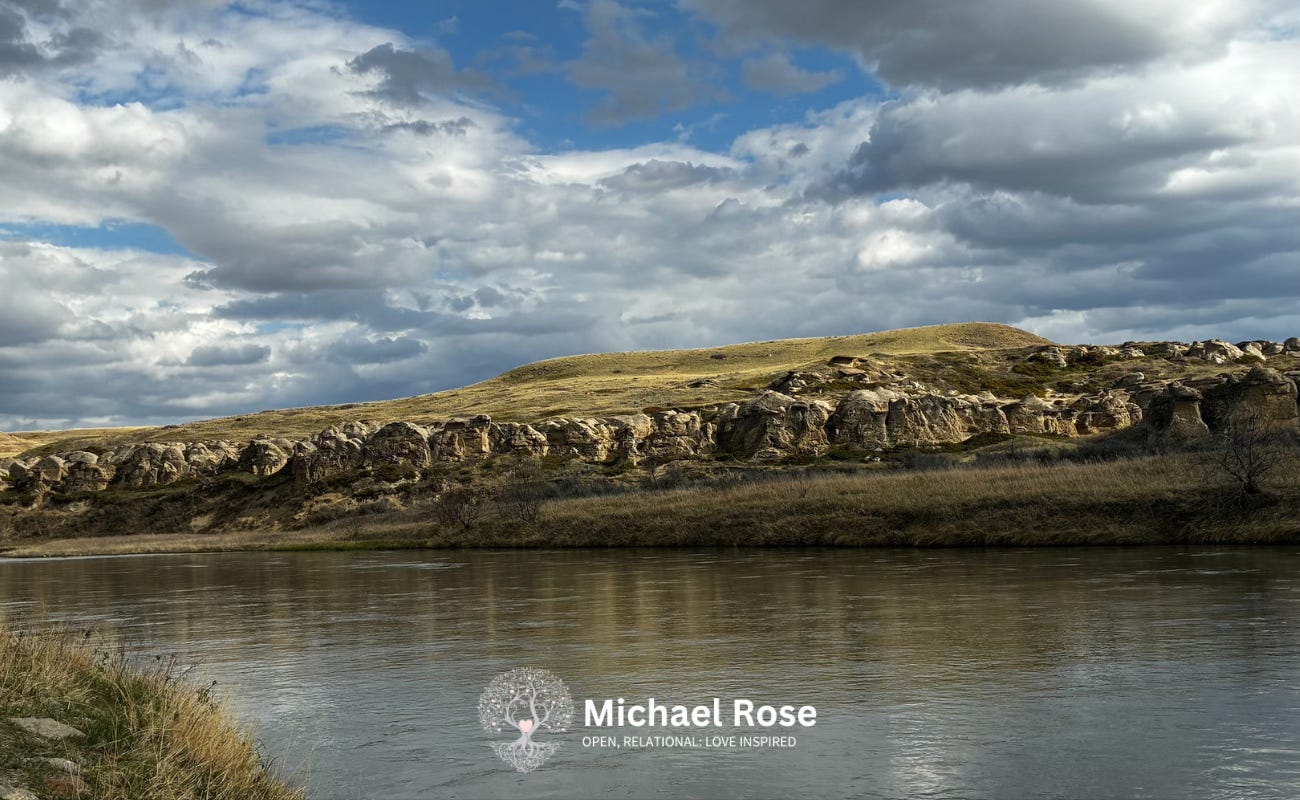
For a while now, I’ve been practicing looking for “good news” stories and paying special attention to things that stir a sense of wonder, awe, and gratitude. This has become, at least in part, a response to the seeming onslaught of bad news: wars, cruelty, greed, disease, outrage, the endless machinery of anxiety and despair.
Not because suffering isn’t real. It is.
But because I’ve begun to suspect that constantly staring into the machinery of despair slowly makes us myopic. We lose our ability to see the fuller picture, especially the glimmers, and sometimes outright explosions, of goodness and love all around us.
The modern world is remarkably good at directing our attention toward what is broken. Entire industries now depend on keeping us consuming, reacting, scrolling, afraid. Doom holds attention longer than delight. Fear monetizes better than wonder.
Over time, I think this does something to us.
We begin to lose our capacity to notice goodness.
Not moral goodness in some abstract religious sense, but goodness in its deeper, older sense. Beauty. Tenderness. Communion. Delight. Care. The strange and persistent emergence of life reaching toward life.
This past weekend, my beloved and I headed south to a provincial park and camped along the Milk River beneath sandstone cliffs and hoodoos, some still marked with ancient Indigenous carvings carved into the stone walls.
The prairie was waking up.
Fresh grass had begun pushing through winter’s faded browns. Wildflowers interrupted the fields with sudden flashes of purple, yellow, orange, and red. Seasonal birds had returned. Calves walked close behind their mothers out on the range.
And then the lambs.
Honestly, I laughed out loud.
They bounded and leapt across the pasture with what appeared to be absolutely no awareness whatsoever of geopolitics, economic collapse, or the latest social media outrage. Tiny wool-covered prophets of joy.
Further south, deer moved through the river valley with this year’s fawns while rabbits darted through the grass halfway between their winter white and prairie-brown coats, as though creation itself was still changing clothes for the season.
Eventually, we found ourselves perched beside the Milk River itself, swollen with spring runoff. Cottonwoods lined the opposite bank while robins splashed along the river’s edge.
The river caught my attention.
At first, it looked unified, one body of water moving southward. But the longer I watched, the more I noticed the smaller movements within it. Eddies. Ripples. Swirling currents. Tiny improvisations moving within the larger flow.
Something about that felt strangely important.
Sitting beside the river, watching those currents within currents, I found myself wondering if goodness works something like this too. Not imposed from somewhere outside the world, but arising from within it. Moving through things. Drawing life toward deeper relation, greater beauty, fuller participation.
That thought stayed with me.
Because somewhere along the way I realized I’ve spent a great deal of my life thinking about the problem of evil.
Why suffering?
Why cruelty?
Why violence?
But what about the problem of good?
Why beauty?
Why compassion?
Why tenderness?
Why awe?
Why does anything in us respond to love at all?
Because honestly, if the universe is merely cold machinery blindly colliding in empty space, then the existence of goodness itself begins to feel astonishing.
Why should matter become music?
Why should stardust become conscious enough to laugh at lambs, grieve losses, write poetry, cradle children, or sit beside rivers overcome with gratitude?
Why should evolution produce creatures capable of compassion?
That question has begun to feel every bit as mysterious to me as the existence of suffering.
Maybe more.
This is part of why thinkers like Pierre Teilhard de Chardin continue to capture my imagination.
Teilhard saw evolution as more than biology unfolding through blind mechanics. Beneath the long story of cosmological and biological emergence, he sensed a deeper movement within things themselves. Matter carried an interiority, a withinness. Consciousness was not an accident arriving late to the universe, but part of the universe gradually waking to itself.
That changes how one sees the world.
The river is no longer merely scenery.
The lambs are not decorative extras.
The prairie itself becomes alive with participation and becoming.
Creation is not dead material waiting for meaning to be imposed upon it from elsewhere. It already shimmers with presence, relationship, possibility.
For Teilhard, Christ was not outside this process looking in. Christ was the deep presence within it. The divine lure, the élan vital, at the heart of becoming itself, drawing creation toward greater complexity, consciousness, communion, and love.
Not coercing. Not controlling. Luring. Inviting. Calling.
This is where process thinkers also feel important to me. They challenged the old image of God as a distant cosmic manager standing outside the universe, pulling strings.
Instead, they imagined reality as relational all the way down.
God not as coercive force imposing outcomes from above, but as creative presence continuously offering possibilities for beauty, harmony, communion, and becoming.
Persuading rather than controlling.
Inspiring rather than coercing.
Participating rather than standing apart.
In this view, goodness is not simply imposed from the outside. It emerges relationally from within, shaped through participation and response, through countless small acts of becoming.
Like eddies in a river.
Maybe the flow itself is love.
Not sentimental love. Not mere feeling. But the deep relational current moving through creation, calling life toward communion, creativity, tenderness, and fuller being.
And maybe this is why paying attention matters spiritually.
Because I suspect wonder is not escapism. I think wonder may actually be one of the ways we recover our participation in reality.
Not shallow positivity.
Not denial.
Certainly not pretending suffering isn’t real.
But remembering that despair does not tell the whole story.
Goodness keeps appearing.
In rivers.
In green grass.
In robins splashing at the water’s edge.
In strangers helping strangers during disasters.
In nurses holding trembling hands.
In neighbours delivering meals.
In people planting gardens after wars.
In communities rebuilding after tragedy.
In the stubborn human instinct to love even after heartbreak.
And honestly, some forms of goodness seem to exceed mere survival utility.
Cooperation and bonding make evolutionary sense, fair enough.
But music?
Beauty?
Art?
Sacrificial love?
Grief itself?
These feel almost excessive.
Grief especially fascinates me.
Why do humans ache so deeply over loss? Why does love leave such a mark on us that absence can feel physical?
Grief reveals something important. It tells us we experience one another as profoundly significant.
Even our outrage at cruelty tells us something.
We do not merely dislike evil because it inconveniences us. Some acts strike us as violations of something deeper. Torture. Humiliation. Abuse of the vulnerable. Betrayal.
Most people experience these things not merely as unpleasant, but as wrong in some deep and visceral sense, as though reality itself protests.
That feels important to me.
Because perhaps evil is recognizable precisely because we already carry some deep intuitive awareness of goodness.
Like a river current, we can feel it even while swimming against it.
Teilhard sensed this current moving through the cosmos itself. Not as naïve progress or inevitable utopia. History ruins those illusions quickly enough. But there does appear to be a long movement toward deeper forms of relation, consciousness, and communion.
Somehow, over immense stretches of time, the universe keeps giving rise to deeper forms of relation. Particles gather into atoms. Atoms into molecules. Life emerges. Consciousness awakens. Eventually, creatures begin wondering about goodness itself.
Something keeps unfolding.
Something keeps reaching toward communion.
And perhaps this is what incarnation really means.
Not God occasionally visiting matter from somewhere else.
But divine presence entangled with creation from the beginning. Breathing within it. Calling from within it. Participating in its long unfolding toward love.
Not above the river.
Within the current.
Perhaps this is why beauty moves us so deeply in the first place.
Why sunsets can leave us quiet for a moment.
Why music sometimes feels like it touches something older than language.
Why a prairie sky full of stars can awaken awe instead of indifference.
Strictly utilitarian explanations always feel incomplete to me there.
Beauty nourishes something deeper than survival.
Maybe beauty is one of the ways reality invites participation rather than mere consumption. A reminder that we are not separate from this vast unfolding story, but participants within it.
And perhaps this is part of the spiritual task now.
Recovering our capacity to notice.
To pay attention again.
To resist the soul-deadening pull of despair and rediscover the ancient, ongoing miracle that this universe somehow became capable of rivers, lambs, tenderness, beauty, compassion, and people who sit beside hospital beds holding trembling hands.
That should probably astonish us more often than it does.
And maybe that astonishment is where wisdom begins.
Sola Caritas,
𝞃Michael
I had the joy of visiting with Tori Owens and Jonathan Foster for an episode of Off Canon Podcast. You can watch it here

Beautiful post, Michael. I agree that beauty is so significant and meaningful and a signpost to something mysterious deeply embedded in reality. I love the idea of the problem of good. This comes up at the end of your recent podcast with Tori and Jonathan and is very interesting there too. The first time I encountered that idea was in Philip Goof's book "Why?" He goes through a bunch of possibilities for how God could be, and he brings up the idea of an all powerful, all knowing, all bad God and says, but what about the problem of good? I laughed out loud when I read that. You have such a beautiful spirit that comes though in your writing and in the podcast.
I love that picture you shared. I grew up 100 miles north of there and think of southern Alberta often.
"Because perhaps evil is recognizable precisely because we already carry some deep intuitive awareness of goodness." This reminds me of the oft used phrase, we don't what this is unless we know what it isn't. Classic dualism is where we are born into and then spend our lives attempting to bring them back into relation. The creative lure of the divine recognizes the reality of evil but through uncontrolling love reminds us that goodness is where we want to go.